Newsletter | Octuber 2026
WHAT WE DISCOVER ALONG THE WAY.


As we move forward, the journey transforms us. Circumstances change, our perspective shifts, and so do we. Sometimes, pausing allows us to recognize how far we have come, discover what we can now let go of, and consciously choose what still feels meaningful to carry with us along the way.
What we discover along the way.
Dear readers, today is one of those days when the fast pace has suddenly come to a halt. Life has kindly invited me to pause and take care of my body. So, as I find myself wandering in places that were once familiar to me, I can’t help but think about how far I’ve come over all these years, how many things have happened out there, and how much has also changed within me.
In this reflection, I recognize that this is how life works. As we move toward what we believe is our path, we discover that the journey is never linear; it’s not just the path that changes, both internally and externally. Circumstances change, our surroundings change, and we change as well. We gradually discover who we are now, who we were in the past, and what we want to carry forward with us.
As time goes by, we also come to realize that coherence is not expressed solely in what we think or feel. It is lived and expressed through our decisions, in the way we relate to others, in how we support them, and in the way we choose to uphold the commitments we have made through our practice—both to ourselves and to those who have trusted us to facilitate their own transformation.
Perhaps one of the most valuable things we discover along our journey is that growth means being able to look at our journey from a new perspective, recognize what has brought us this far, and choose—with ever-greater awareness—what we want to take with us as we move forward.
Some things will have already served their purpose, and we’ll have to let them go. Others may have taken on a different meaning over time. And there will also be those that, after all we’ve been through, we recognize as still being important.
Perhaps that’s why it is worth pausing every now and then, looking back at the path we’ve traveled, and asking ourselves: What have I discovered about myself along the way, and what do I choose from here on?
Thank you for continuing to walk with us. We’ll see you in the next issue.
Ylleana, Norma and Nuria
Resonance Repatterning International Institute Board of Directors
This content is authored by Norma Garcia

CHLOExperiences
“The duality of creation, expressed as yin and yang qualities, makes life possible.”
— Chloe Faith Wordsworth
Wordsworth, Chloe F. (2014), “TRANSFORMACIÓN DE PATRONES DE LOS CINCO ELEMENTOS Y LOS MERIDIANOS CON RESONANCE REPATTERNING” tercera edición de la versión en español, agosto de 2014. Resonance Publishing, p. 3
SpiralMarketing
Energy-Based Leadership: The Presence That Leads
How inner energy defines authentic authority in therapeutic and holistic spaces.
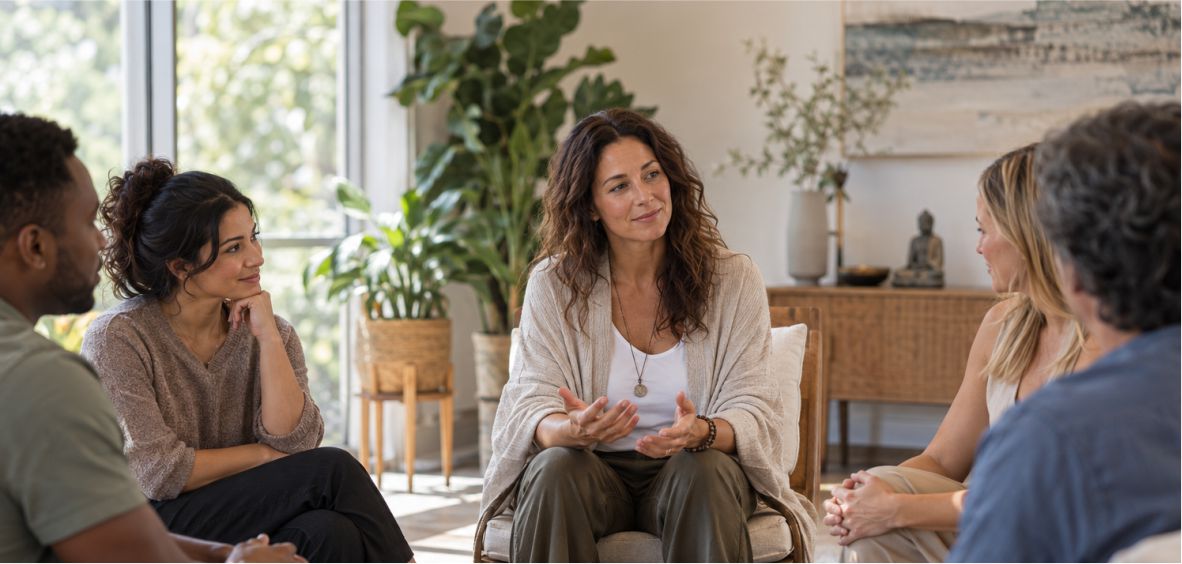
Authentic leadership is neither imposed nor proclaimed. It is perceived. Before any role, title, or recognition, leadership emerges from the energy with which a person inhabits their presence. In therapeutic and holistic environments, this quality is especially evident: guidance comes more from what is radiated than from what is said.
Leading from energy means taking responsibility for one’s inner state. It is not about being constantly available or holding everything together, but about maintaining coherence between intention, words, and actions. Authentic authority does not arise from control, but from clarity and integrity.
When someone leads from their center:
- They inspire trust without imposing rigid boundaries.
- They offer direction without pressuring another’s process.
- They hold space through presence, not effort.
This form of leadership creates safe environments where growth unfolds naturally. Energy becomes a container that guides without invading, that supports without directing. In this balance, leadership stops being a burden and becomes a living expression of service.
October invites us to reflect on how we lead in our practices, communities, and spheres of influence. To ask whether our presence guides from coherence or scatters under external expectations. Because leadership is not about doing more — it is about being more integrated.
Energy-based leadership does not seek followers; it cultivates autonomy. It does not aim to prove authority; it embodies it. And when inner energy is aligned, presence itself becomes the reference — a quiet guide that leads without needing words.
This content was written by Américo Espinoza
FOCUS
From the Map of Heaven to the Map of the Body
Qi as the Common Thread in the Expression of Yin and Yang
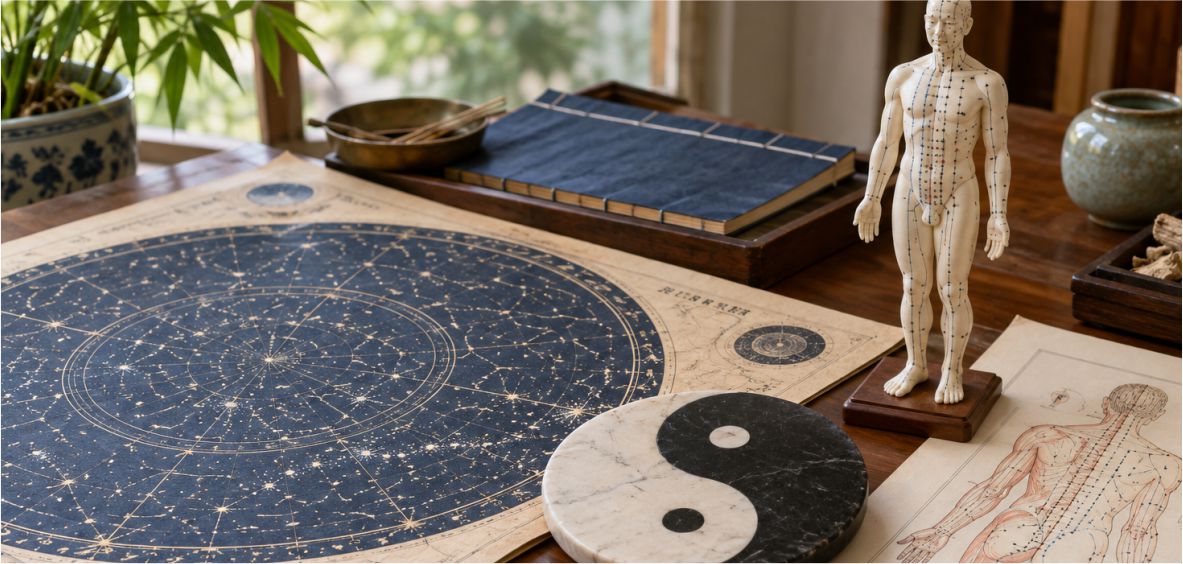
As we trace the map of time and space to understand the workings of nature, we observe that Qi, as the vital energy of the universe, carries within its flow the vibration that brings movement to the Earth. This vibration manifests in the different movements generated as the Earth rotates on its axis while simultaneously orbiting the Sun.
As the Earth travels around the Sun, the Five Movements/Elements—Wood, Fire, Earth, Metal, and Water—allow us to describe, within this conceptual framework, different phases of transformation that correspond to the cycle of the seasons.
In this journey of Qi through time and space, we can observe how the Five Movements/Elements interact with one another and create seasonal phases or transitions: spring turns into summer; summer passes through a late phase as it draws to a close; then it turns into fall and fall into winter.
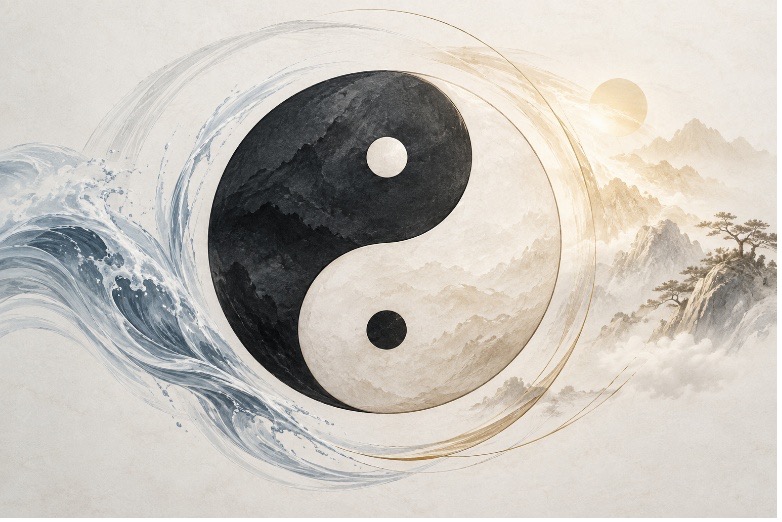
During these transitions, countless cyclical processes of change take place on the planet, regulated by the dynamic balance of Yin and Yang. Within this dynamic, these opposing forces never cancel each other out: when Yin grows, Yang wanes, and when Yang grows, Yin wanes. Both principles are in a continuous state of alternation and transformation.
Yin and Yang coexist continuously within this dynamic of change. The flow of each makes room for the flow of the other, thereby enabling their mutual existence and symbolizing the constant transformation of the cosmos. This balance always contains the seed of imminent change.
What do we need to understand about Qi in order to move naturally from the macrocosm to the human microcosm?
From the perspective of Traditional Chinese Medicine (TCM), the patterns of change and transformation we observe in nature have their counterparts in living beings. Human beings are part of this natural order and, from this perspective, are understood as a microcosm within the macrocosm.
The teachings of TCM describe how these patterns manifest in the microcosm of the human body. TCM views the human being as a microcosm through which vital energy, or Qi, circulates, following the same principles of change and transformation as the Tao. Qi is expressed through Yin and Yang qualities and dynamics, which allow us to understand its various manifestations within the body. Within this conceptual framework, Qi flows through the body via channels called meridians and participates in its various physical, mental, emotional, and spiritual functions.
How do time and space — the macrocosm — influence the human body?
It is fascinating to observe how TCM recognizes the pattern of dynamic balance and the expression of Yin and Yang qualities in the macrocosm. From this perspective, the human body is a microcosm within the cycles of nature.
The cycle of day and night offers an excellent example of how, from the perspective of TCM, energy is expressed in our everyday environment through the qualities of Yin and Yang. The alternation between light and darkness can be understood through these qualities: activity and expansion during the day; withdrawal and rest during the night.
Living beings respond in different ways to this alternation: some species are most active during the day, while others are most active at night. Something similar occurs in humans. There are individual differences in our patterns of activity and rest: some people function best during the day, others around twilight, and still others are most active during the early hours of the night.
From a completely different perspective, modern chronobiology has shown that numerous internal physiological rhythms are synchronized with periodic signals from the environment. The alternation between light and darkness, generated by the Earth’s rotation, acts as one of the main synchronizers of our circadian clock, which, in turn, coordinates multiple rhythms in organs and tissues. Thus, processes such as sleep and wakefulness, hormone release, and metabolism are part of a dynamic temporal organization linked to the day-night cycle.
Contemporary science allows us to observe, through its own language and using measurable mechanisms, that our physiology possesses a temporal organization that encompasses multiple physiological, hormonal, and metabolic processes.
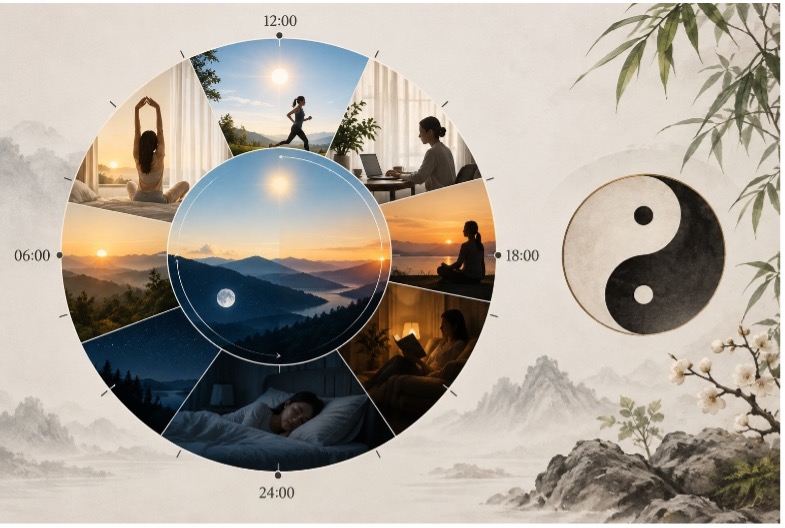
TCM describes this integration between human beings and nature through its own conceptual framework, using the dynamics of Qi and the qualities of Yin and Yang. From this perspective, health is understood in terms of dynamic balance. When Yin or Yang lose their harmonious relationship, that balance can be disrupted and affect health.
So far, we have traced Qi from the Map of Heaven to the Map of the Body: from the patterns of change we observe in nature to the way TCM recognizes them in the human microcosm.
In our next installment, we will take a closer look at this map to discover how the qualities of Yin and Yang are expressed in the body and how their dynamic relationship forms part of the understanding of health in Traditional Chinese Medicine.
Sources:
- Raphals, Lisa. “Chinese Philosophy and Chinese Medicine.” Stanford Encyclopedia of Philosophy.
- Flower, A.; Lewith, G.; Little, P. et al. “Applying the Principles of the Five Phase (Wu Xing) Model to Inform Good Practice for Studies of Chinese Herbal Medicine.”
- Escuela Li Ping de Acupuntura y MTC. Tema 2: El Yin y el Yang.
- National Institute of General Medical Sciences, NIH. Circadian Rhythms.
- Farhud, D.; Aryan, Z. “Circadian Rhythm, Lifestyle and Health: A Narrative Review.” Iranian Journal of Public Health, 47(8), 2018, 1068–1076.
Content written by Nuria Becerril
FIND OUT MORE!