Newsletter | September 2026
THE PATH IS BUILT STEP BY STEP.

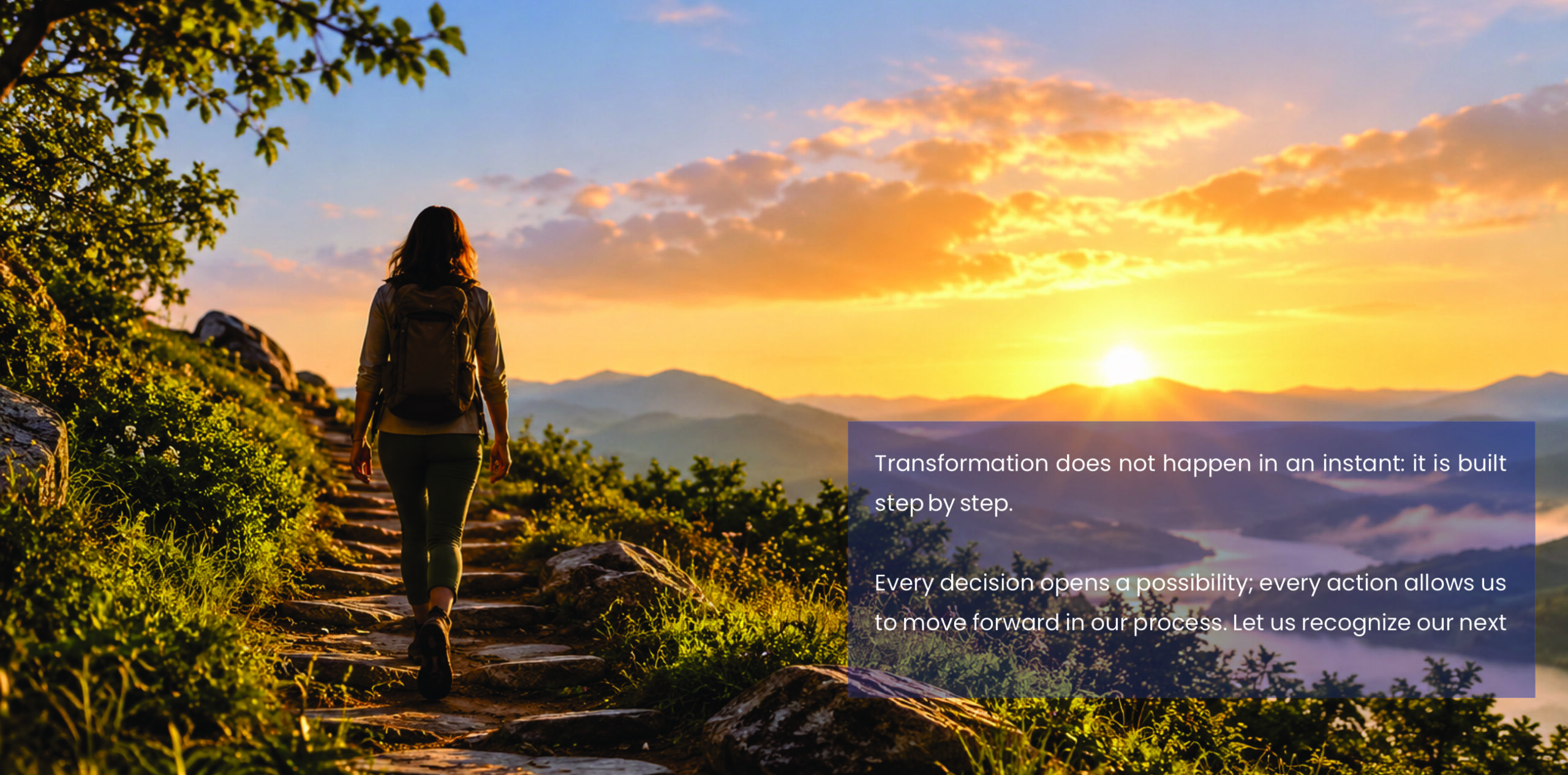
Transformation does not happen in an instant: it is built step by step. Every decision opens a possibility; every action allows us to move forward in our process. Let us recognize our next step and continue the path of transformation with presence, coherence, and openness to new possibilities.
The path is built step by step.
Dear readers, it is September and the year feels as though it were about to end; days seem to pass more quickly as if they had fewer hours. I know there are times when we wish that internal changes could happen just as quickly. Have you ever wished that the change you have longed for could happen all at once? Perhaps we would like to make a single decision, understand something important, have a deeply transformative experience and, from that point on, never return to where we came from.
But those of us who have walked a path of transformation know that it rarely happens that way.
Sometimes we take a big step forward and, sometime later, a seemingly familiar situation arises again. An emotion, a fear, a challenging relationship or even a pattern we thought we had left behind resurfaces. And then we ask ourselves: “Am I here again?” “Haven’t I already worked through this?” “Why do I keep running into the same thing?”
In such a situation, one of the most important things we can learn is that encountering something familiar again does not necessarily mean returning to the same place under the same circumstances. When that happens, we may realize that we are no longer that same person.
Every experience we go through, every realization, every new decision, every change in our own resonance, every new possibility we integrate, and every process of spiraling up gradually transforms the way we relate to ourselves and to what is happening around us.
That is why I like to view life through the tools that Resonance Repatterning offers, because the path of transformation resembles a spiral more than a straight line. And we can see this clearly. At times it may seem as though we are passing through the same point again, but if we observe carefully, we discover that we are doing so but from a different place, with a distinct perspective and novel resources to respond. We have raised our consciousness to a higher octave.
Perhaps the situation we are facing is similar, but this time we recognize what is happening sooner. Maybe, this time we are able to set a boundary where we used to remain silent; perhaps, we can more easily make a different choice, ask for help, express how we feel, or pause before responding automatically.
And those changes, although they might sometimes seem small to us, are in fact far from it. At Resonance Repatterning® we work precisely with those patterns which, without our realization, influence the way we think, feel, make choices, and relate to others. A session can open a new possibility, allow us to recognize something that, until then, had remained outside our awareness, or help us to rediscover the resources we need to move forward.
Opening up a new possibility does not mean that the journey is over. When you have your first session, you are opening the door, but the decision to move towards that new reality is yours, and transformation usually unfolds through a broader process.
Over time we discover that, what once overwhelmed us, no longer does so in quite the same way; what took us days or months to process, we may now recognize almost immediately; a situation that once seemed to have no way out begins to reveal alternatives to us. And yes, life will continue to present us with challenges, but we have changed the way we face them.
From that perspective, we may realize that transformation processes are not necessarily spectacular. They often unfold quietly and gradually, but when we look back, we can see that where we are now is completely different from where we were before.
In our last issue, we talked about how everything begins with a decision. Today I would love to share with you that, in many cases, that first decision only allows us to see the next step. And that is fine: that is what taking one step at a time is all about. The great transformations in our lives are built, integrated, and experienced little by little, as we keep walking. As the poet Antonio Machado wrote: “Traveler, there’s no road, the road is your travelling” – translated by Kline, A.S.
Thank you for continuing to walk with us. See you in the next issue.
Ylleana, Norma and Nuria
Resonance Repatterning International Institute Board of Directors
This content is authored by Norma Garcia

CHLOExperiences
“¿What is my next step?” ~Como nos recuerda Chloe Faith Wordsworth en Asciende en espiral 127.
Wordsworth, Chloe F. (2017), “¡ASCIENDE EN ESPIRAL! 127 OPCIONES ENERGETIZANTES PARA REALIZAR TU POTENCIAL AHORA” primera edición en español, Resonance Publishing, p. 302

SpiralMarketing
Effortless Marketing: Strategies for Natural Connection.
How to attract without chasing, connect without pressure, and communicate without exhaustion.
For a long time, marketing has been associated with pushing, insisting, and constant visibility. Yet within conscious spaces, this approach often leads to fatigue, disconnection, and a sense of ongoing effort. Genuine affinity cannot be forced — it must be allowed to emerge.
Effortless marketing does not mean lack of intention; it means clarity in how relationships are built. It begins with understanding that people are not drawn to pressure, but to coherence. When communication arises from presence, connection happens naturally, without the need to chase outcomes.
Approaches built on affinity are sustained by the quality of the encounter, not the quantity of impressions. They do not seek to convince, but to invite. They do not push decisions but create space where others can recognize themselves and choose at their own pace.
Communicating without effort means:
● Respecting the other person’s timing without abandoning your own.
● Sharing from clarity rather than urgency.
● Trusting that the right message arrives when energy is aligned.
When marketing begins to feel exhausting, it is often a sign that connection is no longer flowing naturally. Forcing visibility, competing for attention, or maintaining a rhythm that does not resonate weakens both communication and connection. Authentic closeness, on the other hand, feels light and sustainable.
September invites us to reflect on how we approach those we wish to support. To ask whether our communication creates openness or tension. Because attracting without effort is not about doing less — it is about acting from a more aligned place.
Effortless marketing does not eliminate strategy; it humanizes it. It restores its original purpose: facilitating meaningful encounters. And when closeness is built from coherence, communication stops being a burden and becomes a living bridge between intention and resonance.
This content was written by Américo Espinoza
FOCUS
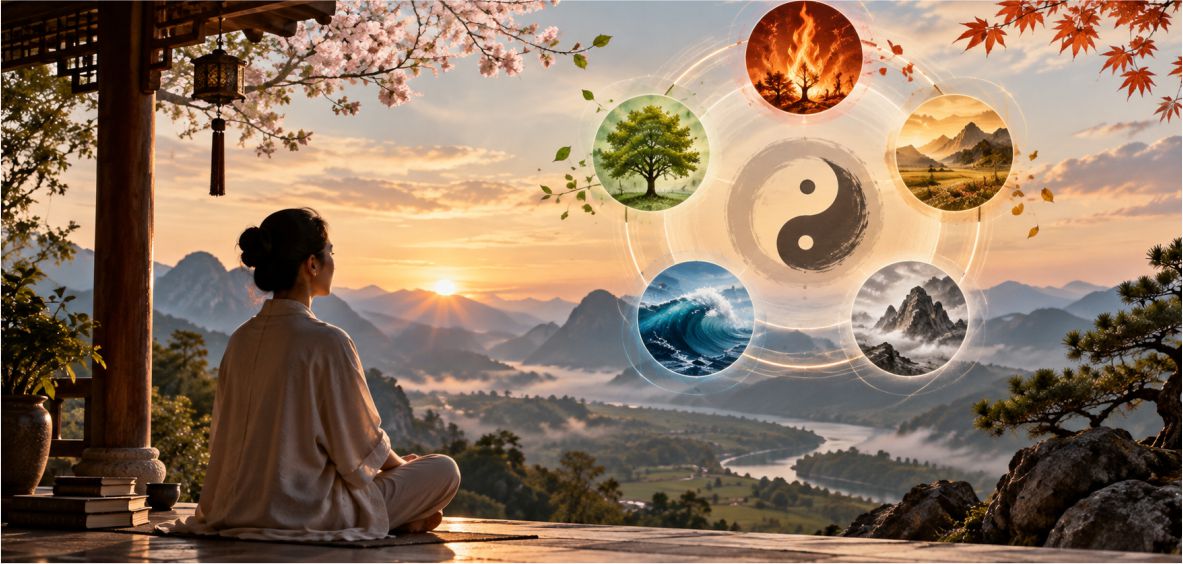
Wu Xing: A Living Map of Relationships
One Dynamic, Two Realms
For centuries, Chinese observers looked to the heavens and to the natural world to understand the rhythms of time and the patterns of transformation unfolding around them. They observed the cycles of the heavens, the changing seasons, and the five movements or phases of transformation known as Wu Xing, recognizing correspondences between these larger rhythms of nature and their manifestations in human beings and other living things. Drawing on concepts such as the Tao and the Yin-Yang duality, different Chinese traditions gradually developed ways of expressing these observations around a fundamental question:
How does the human being participate in the cycles and transformations of nature?
These traditions shared a common cosmological language, although they turned their attention to different fundamental realms in order to answer this primordial question.
Throughout history, numerous ways of understanding and seeking balance in human beings have also emerged. Ancient traditional accounts attributed to Emperor Yinkang describe the practice of therapeutic Wu dances to mobilize the body and prevent stagnation in damp conditions. Thus, from time immemorial, we find this quest for wellbeing and health to be an integral part of human life.
Over time, this quest for balance through movement became part of an increasingly broad cultural and intellectual context. By the Warring States period and the early imperial centuries of the Han dynasty, various concepts began to be progressively systematized and articulated until they were integrated into ever more complex frameworks.
Philosophical concepts such as the Tao, the Yin-Yang duality, and the Five Phases — the five elements — evolved and became integrated within a broad cosmological framework that gave rise to various interrelated forms of knowledge.
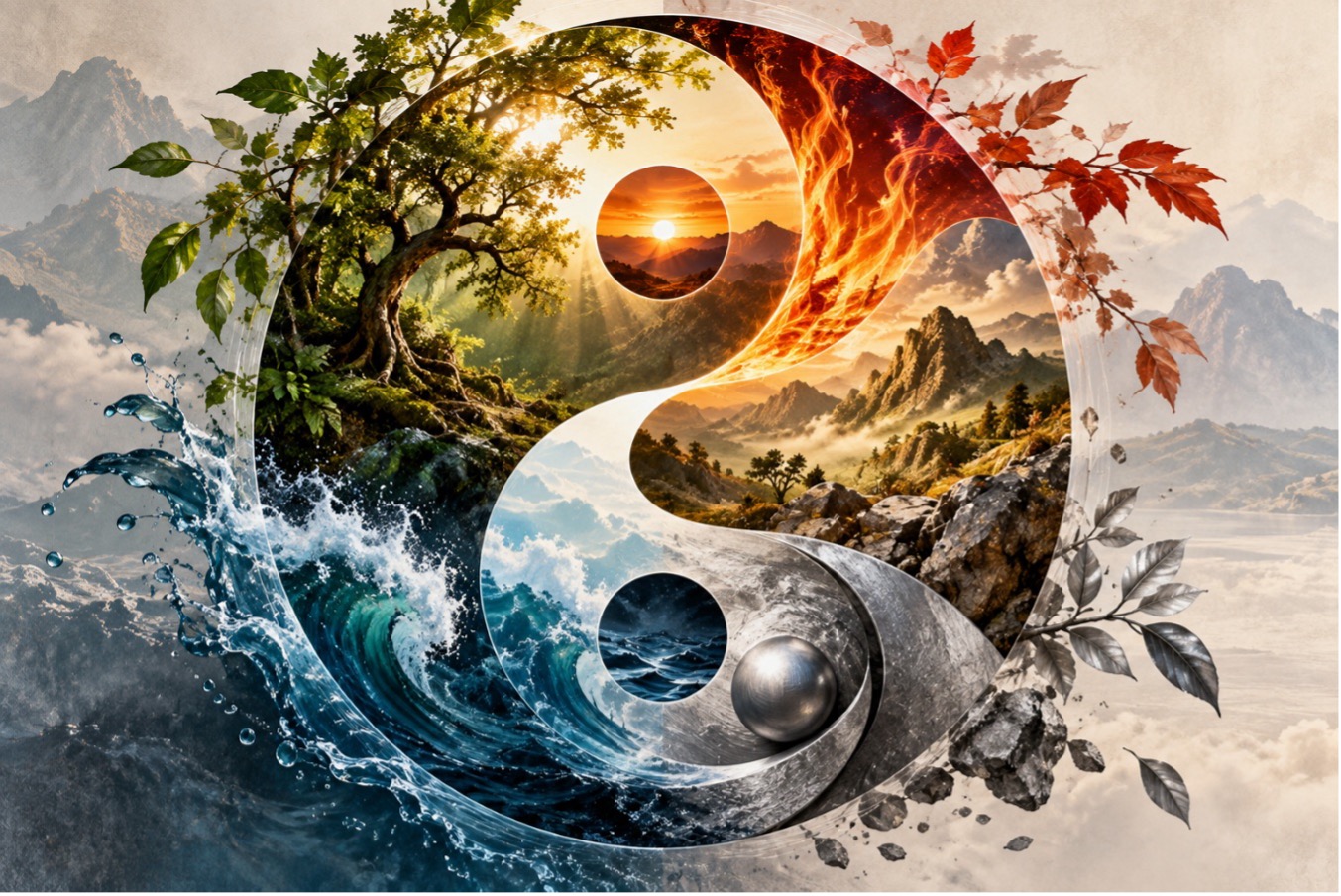
This shared cosmological framework found expression in different realms: in BaZi, as a language for understand time and destiny; in Daoyin, through the pursuit of balance by means of movement, breathing and the cultivation of vitality; and in Chinese medicine, as a framework for understanding the body, its organs and the relationships between them.
In this process of integrating medical knowledge, the Huangdi Neijing—traditionally attributed to the Yellow Emperor—emerges as one of its major bodies of reference. The Neijing articulates concepts such as the Yin-Yang duality and the Five Phases to the internal organs and to an extensive network of correspondences—many of which we are already familiar with, thanks to our exploration of the Wu Xing and BaZi. Furthermore, the relationship between the internal organs, Qi and the network of channels running through the body is explored, forming a dynamic system of relationships that seeks to understand the balance of the human being across their physical, mental, emotional, and spiritual dimensions.
The five elements found in BaZi now reappear as a map of relationships within the body.
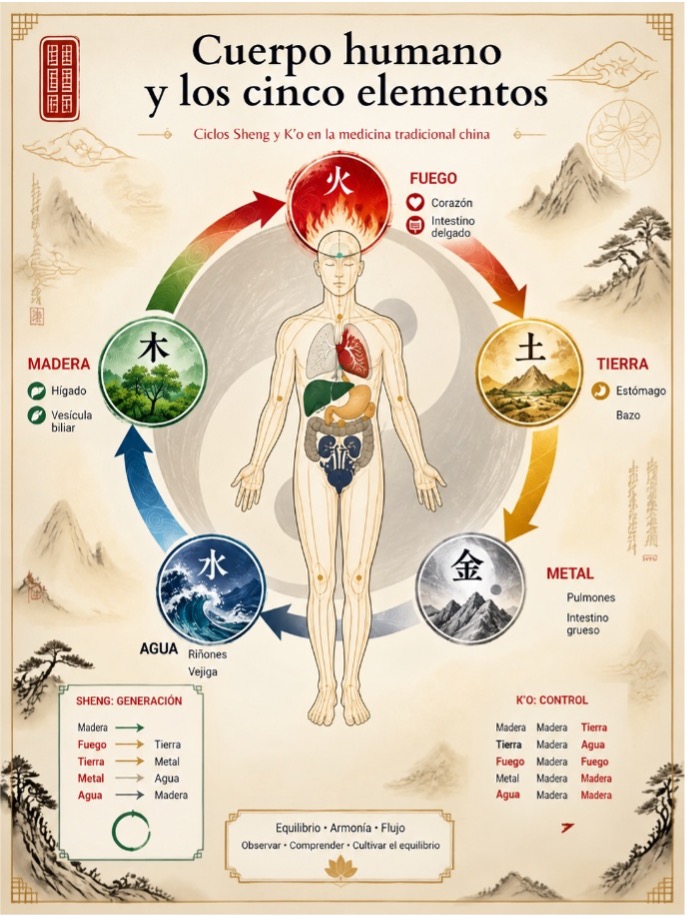
Just as nature expresses itself through dynamics of transformation and balance, the human body can also be understood as a dynamic network of relationships through which Qi circulates via channels — the meridians — associated with different organs and functions. Within this conceptual framework, Chinese acupuncture developed as a therapeutic practice aimed at supporting regulation and balance within these bodily dynamics.
In our forthcoming instalments, we will explore these bodily and functional correspondences of the Five Elements from the perspective of traditional Chinese medicine, and we will see how this map of relationships manifests itself in emotions, physiology, the mind and the spirit through the different cycles of the Five Elements and their relationship with the internal organs and meridians.
Fuentes:
- Chen, X., Cui, J., Li, R., Norton, R., Park, J., Kong, J. & Yeung, A. (2019). Dao Yin (a.k.a. Qigong): Origin, Development, Potential Mechanisms, and Clinical Applications. Evidence-Based Complementary and Alternative Medicine, 2019, 3705120. DOI: 10.1155/2019/3705120. PMID: 31772593.
(PubMed) PubMed - Zhang, W.-B. (2013). Analysis on the concepts of qi, blood, and meridians in Huangdi Neijing (Yellow Emperor’s Canon of Internal Classic). Zhongguo Zhen Jiu, 33(8), 708–716. PMID: 24195212. (PubMed) PubMed
- Singh, K., Gupta, J. K., Jain, D., Kumar, S., Singh, T. & Saha, S. (2024). Exploring the ancient wisdom and modern relevance of Chinese medicine: A comprehensive review. Pharmacological Research – Modern Chinese Medicine, 11, 100448. DOI: 10.1016/j.prmcm.2024.100448.
- Lo, V. (2009). But is it [History of] Medicine? Twenty Years in the History of the Healing Arts of China. Social History of Medicine, 22(2), 283–303. DOI: 10.1093/shm/hkp004. https://doi.org/10.1093/shm/hkp004
- Harper, D. J. The Han Cosmic Board (Shih). Early China. 1978; 4, 1–10. doi:10.1017/S0362502800005836 (Cambridge University Press) Cambridge Core
- Stanford Encyclopedia of Philosophy. Raphals, Lisa, “Chinese Philosophy and Chinese Medicine”, The Stanford Encyclopedia of Philosophy (Summer 2021 Edition), Edward N. Zalta (ed.), URL = <https://plato.stanford.edu/archives/sum2021/entries/chinese-phil-medicine/ (Enciclopedia de Filosofía de Stanford) Stanford Encyclopedia of Philosophy
- Da wu, Instituto QiGong Barcelona; NLS 7/2026. Web. Fuente de divulgación. Consulta: 26ago26; tomado de https://institutoqigong.com/qigong/da-wu/
Content written by Nuria Becerril
FIND OUT MORE!