Newsletter | November 2026
LOOKING AGAIN THROUGH NEW EYES.
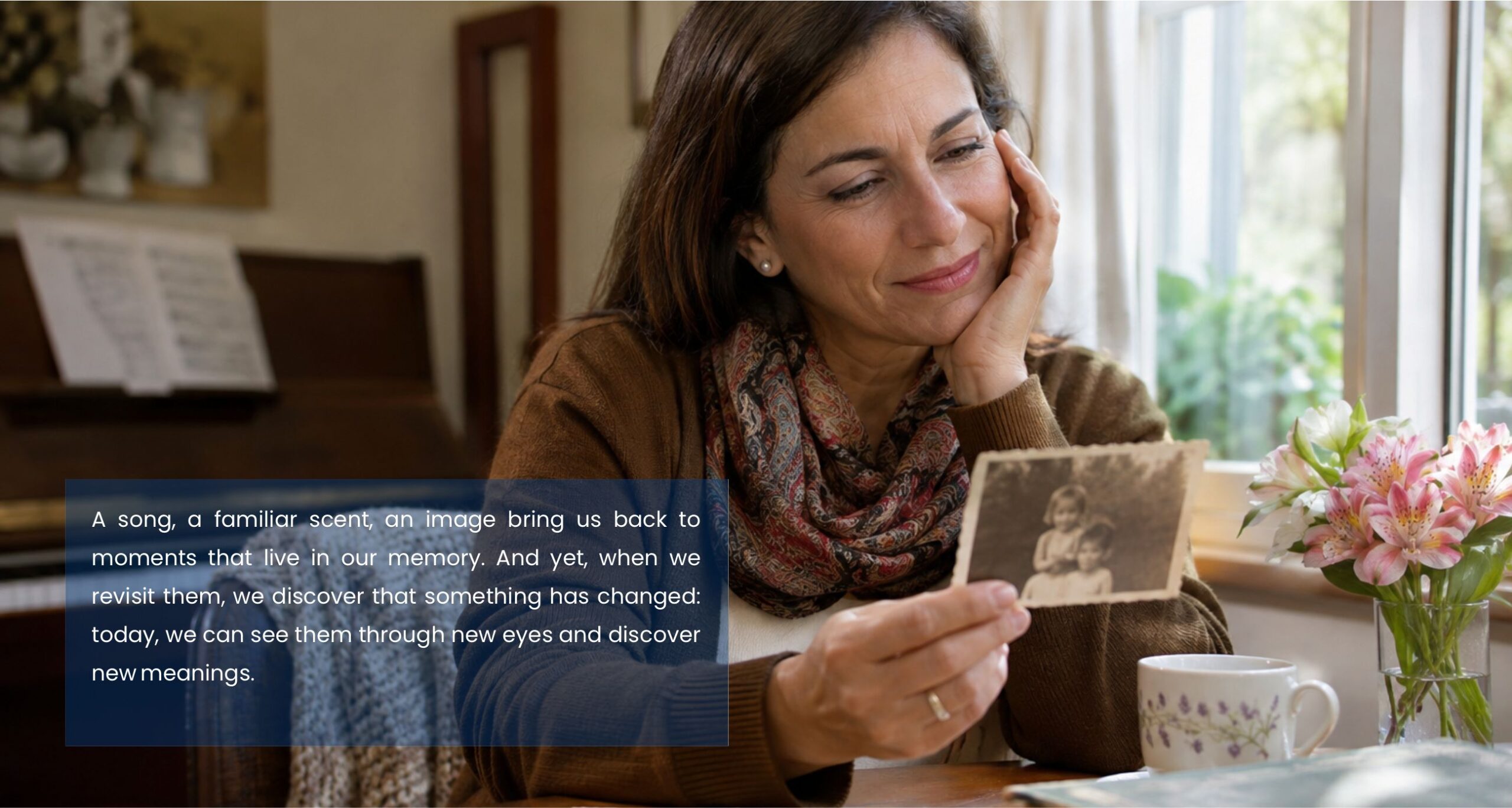
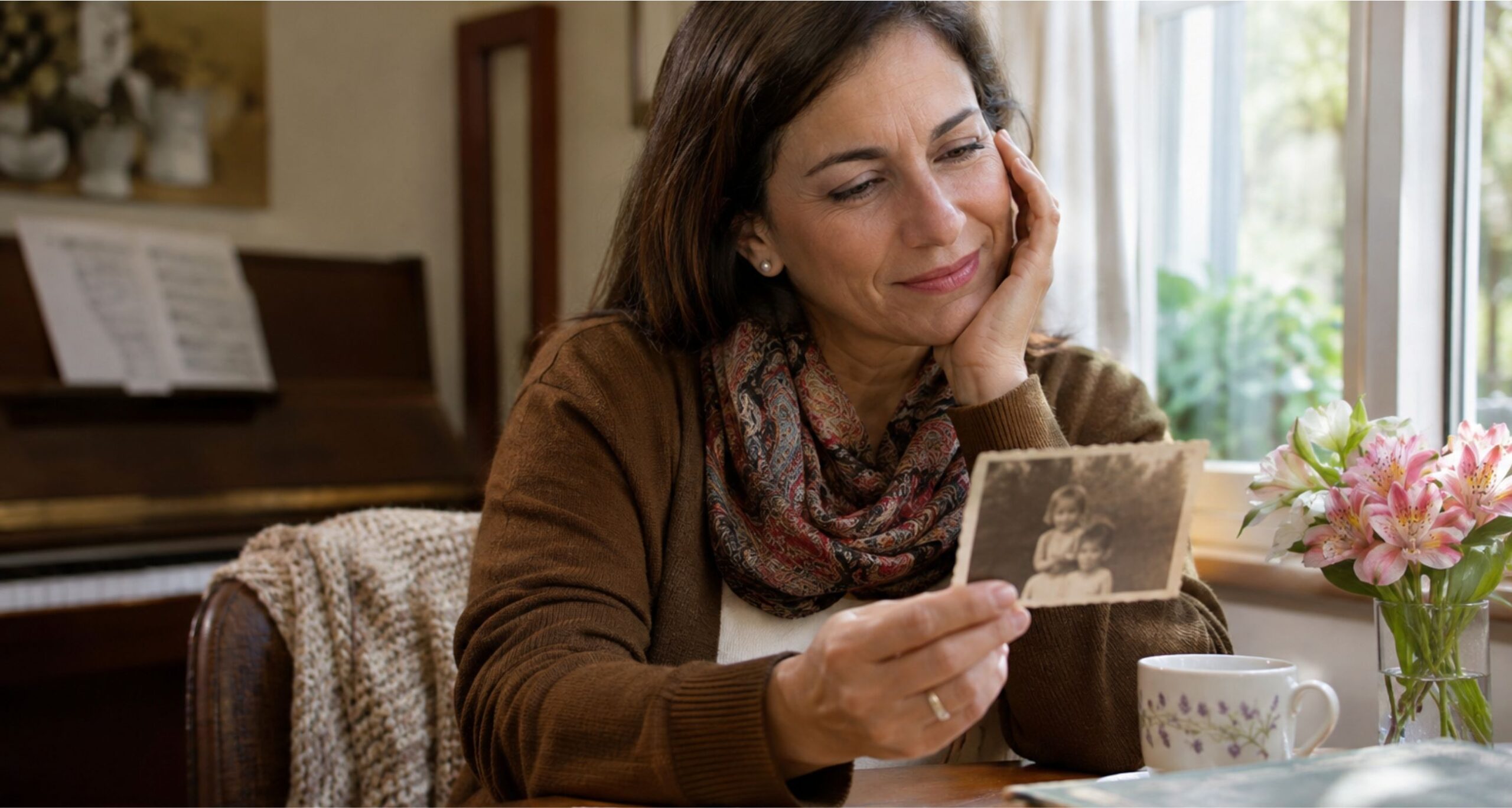
A song, a familiar scent, an image bring us back to moments that live in our memory. And yet, when we revisit them, we discover that something has changed: today, we can see them through new eyes and discover new meanings.
Looking Again Through New Eyes.
Dear readers, November has arrived, bringing with it traditions from around the world that invite us to remember those who walked before us, those who were part of our story and who continue to hold a special place in our lives, even though they are physically no longer with us.
This time I invite you to take a moment to think about your own memories and what they awaken within you. Sometimes, all it takes is a photograph, a song, a familiar scent, or returning to a place that was once important to us, and suddenly, moments that seemed so distant come back to mind.
Today was one of those days when, as I was preparing the items I traditionally gather in my home at this time of the year to remember and honor my ancestors, a question naturally came to mind: Have you ever noticed how the same memory can awaken completely different emotions depending on where you are in your life when you revisit it?
Perhaps something you once remembered with sadness, anger, or pain can, years later, be seen with greater serenity when you revisit that experience or remember that person. You may even discover aspects you were unable to appreciate before.
Has this ever happened to you? It doesn’t mean that the experience itself has changed. What has truly changed is the way you see it and how you relate to what you lived through.
As we journey through life, we begin to discover that our own transformation does not necessarily follow a straight line. Sometimes, we encounter familiar situations, memories, or experiences again, but from a different place within ourselves. If we imagined our journey through life as a spiral, we might recognize that even when we pass through familiar places again, we do so from a different perspective. And then we discover that, although the path may feel familiar, we are no longer the same people we once were.
In Resonance Repatterning®, we recognize that our experiences may be connected to unconscious patterns and responses that influence the way we perceive reality. We also know that by working with our own resonance, we can open ourselves to a universe of infinite possibilities. Not because we have changed the past, but because, as we continue working on ourselves, we gradually stop resonating with those patterns from our past that limit the way we live in the present.
Perhaps one of the most beautiful aspects of this process is that, as we continue to transform and release patterns from the past that have been affecting our present, our relationship with our surroundings and with life itself begins to change as well.
Some changes can be felt from the very first moment, while others require time, consistency, and support. Yet it is entirely possible to live a fuller, more authentic, and happier life when we commit to ourselves and to an ongoing process of transformation through Resonance Repatterning®.
If you feel that the time has come to take the helm of your own ship and would like support along your journey, I invite you to connect with one of our wonderful Certified Practitioners who hold a current License to Practice. Whether you are nearby or on the other side of the world, you can always find someone to accompany you:
https://resonancerepatterning.com/find-a-qualified-licensed-practitioner/
And if this journey inspires you to explore more deeply, learn about the system, or discover how to accompany others through their own transformation processes, you may find our Basic Seminar Series especially interesting:
https://resonancerepatterning.com/seminars/seminar-schedule/
Our authorized Teachers will be delighted to guide and support you throughout this journey of learning and training:
https://resonancerepatterning.com/accredited-instructors/
Moving forward can also mean looking back at the past from a different place within ourselves. So perhaps this November, as we remember and honor those who have been part of our lives, we can also give ourselves the opportunity to look at our own stories through new eyes and recognize just how much we have changed.
Thank you for continuing to walk this path with us. We look forward to connecting with you again in our next edition.
Ylleana, Norma and Nuria
Resonance Repatterning International Institute Board of Directors
This content is authored by Norma Garcia
CHLOExperiences
“The best use of our Jing life energy is to activate it by turning inward to manifest our spiritual potential”
— Chloe Faith Wordsworth
Jing: our inherited vital essence.
Wordsworth, Chloe F. (2018), “INNER CULTIVATION THROUGH THE TWELVE MERIDIANS. THE FIVE ESSENCES” eighth edition, Resonance Publishing, p. 2
SpiralMarketing
Resonant Loyalty: Beyond Service.
How to build community, continuity, and trust through coherence and human presence.
Loyalty is often understood as a strategy to ensure people return. Yet in conscious spaces, continuity is not built through incentives or promises, but through the lived experience of connection. People do not necessarily stay solely because of what they receive; they also need to feel supported.
Resonant loyalty arises when the relationship moves beyond a single exchange and becomes a space of trust. It is not about retaining, but about accompanying. Not about guaranteeing continuity, but about creating such a coherent experience that connection sustains itself naturally.
When a practice, space, or individual communicates from coherence, a stable relational field is created. Within that field, clients do not feel like just another number, but like part of something alive. Trust does not emerge from repetition, but from consistency between presence, words, and actions.
Resonant loyalty is built when:
- Communication is clear, honest, and consistent over time.
- The relationship is cared for even when no session is taking place.
- The human experience is valued as much as the service itself.
At this level, the relationship shifts from transactional to relational. Community is not forced or designed as a tactic; it emerges when people feel seen, heard, and respected in their process.
November invites us to reflect on the kind of relationships we are building. To observe whether they are sustained by habit or by resonance. Because authentic loyalty does not arise from dependency, but from mutual trust and the freedom to choose to remain.
Going beyond service means understanding that every interaction leaves a trace. And when that trace is shaped by coherence, presence, and human care, the relationship strengthens organically. Resonant loyalty does not seek to secure the future — it honors the present. And from there, continuity unfolds.
Written by Américo Espinoza.
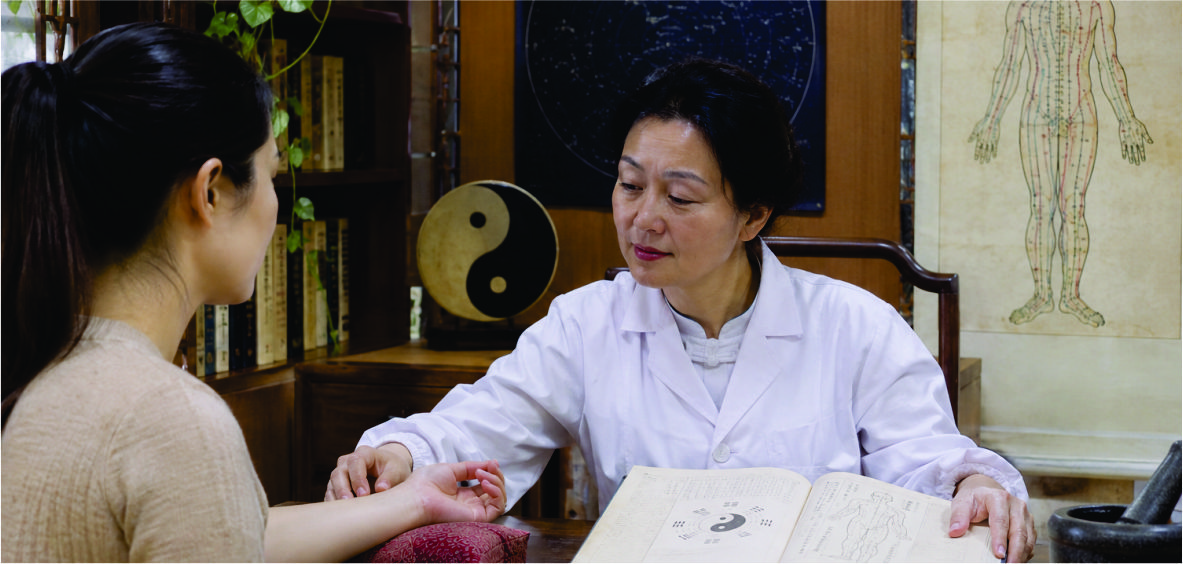
FOCUS
From the map of the sky to the map of the body
The Theory of Yin and Yang from the perspective of Traditional Chinese Medicine. How it manifests in the human body.
In our previous installments, we have explored the concept of Yin and Yang from the perspective of BaZi. This approach has enabled us to understand how this Yin-Yang duality manifests itself in nature. We have also examined the TCM perspective on the expression of Yin and Yang in nature and how the human organism accordingly responds to these stimuli.
Today we begin our journey into the map of the body, where we will learn about the Traditional Chinese Medicine (TCM) perspective on the qualities of the Yin-Yang dynamics.
From the perspective of Traditional Chinese Medicine (TCM), Yin-Yang duality provides one of the fundamental theoretical frameworks for understanding diagnosis and treatment. Thus, BaZi and TCM share cosmological concepts but employ different systems of interpretation, each with its own subject matter and purpose.
To achieve our aim in undertaking this journey, it is important to bear in mind the dynamics of Yin and Yang. In TCM, the scope of Yin and Yang extends beyond abstract philosophy. Health is not a static state, but a dynamic and ever-changing balance between Yin and Yang. The human body is conceived as a microcosm in which these two opposing yet complementary forces constantly interact. Within this theoretical and practical framework, health is understood as a state of balance and illness as an imbalance. More specifically, TCM is based on identifying patterns of excess or deficiency of Yin or Yang.
The theory of Yin and Yang is at once simple, universal, and flexible. By following its principles, practitioners of Traditional Chinese Medicine (TCM) can categorize every symptom, every part of the body, organ function, property, treatment approach and the qualities of the herbs used in such treatments according to their fundamental polarities, thereby creating a unified system for understanding the complex processes that take place in the human body.
A brief look at history
The roots of Yin-Yang philosophy can be traced back to ancient China. In the Yi Jing (Book of Changes), these relationships enable the interpretation of nature’s transformative processes.
Subsequently, the Huangdi Neijing (Yellow Emperor’s Inner Classic) incorporated these principles into the medical approach, laying the foundations for Traditional Chinese Medicine (TCM).
The visual representation of these concepts also evolved. During the Song dynasty, the philosopher Zhou Dunyi (1017–1073) used his Taijitu to explain how movement and stillness contribute to the manifestation of natural phenomena. His diagram, composed of interrelated circles, expressed a cosmological view of the universe.
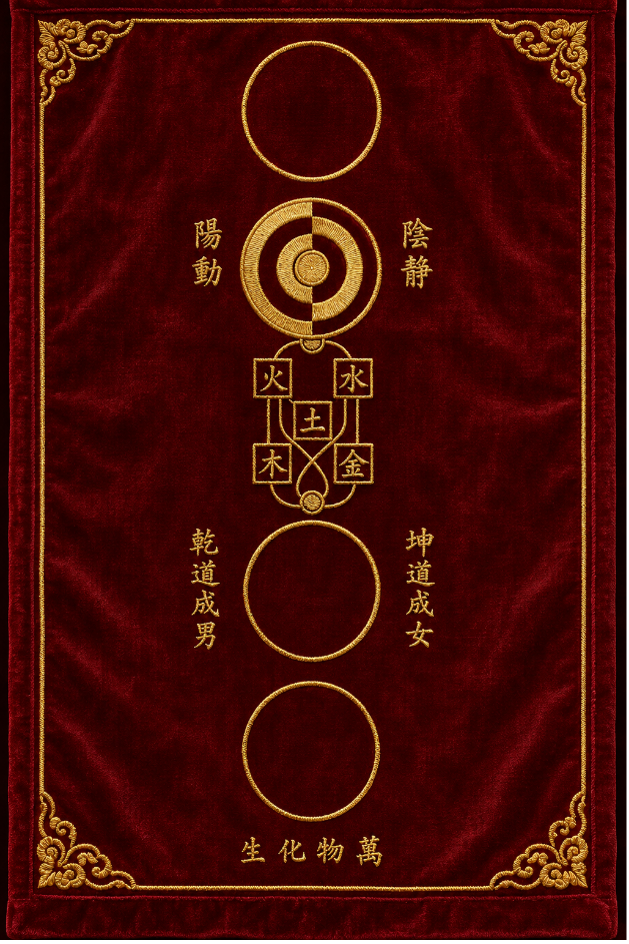
Figure 1. Diagram of the Taiji attributed to Zhou Dunyi (1017–1073). Reproduced from Joseph Needham (1956), cited by Louis (2003).
Centuries later, Zhao Huiqian (1351–1395) recorded and interpreted, in his work Liushu Benyi, a diagram known as the Tiandi Ziran Hetu, which incorporated the intertwined swirling forms of Yin and Yang. As François Louis (2003) explains, this account constitutes an important reference for understanding the historical evolution of the symbol we now recognize as the Taijitu.
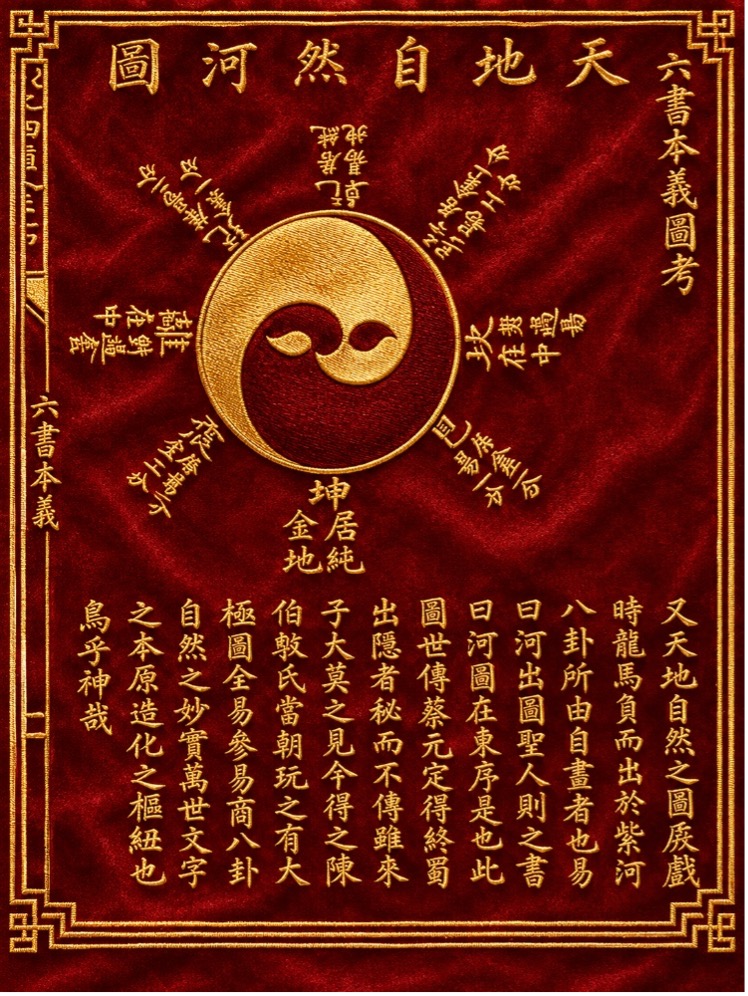
Figure 2. Historical background of the Taijitu. Depiction of the Tiandi Ziran Hetu diagram, documented by Zhao Huiqian (1351–1395) in his work Liushu Benyi, during the Ming dynasty. Source: Louis, F. (2003), The Genesis of an Icon: The “Taiji” Diagram’s Early History, pp. 170–172.
Beyond its diverse representations, the symbol invites us to recognize an essential idea: Yin and Yang are not static states, but complementary aspects of a reality in constant transformation.
The four interactions
Have you ever looked closely at the Taijitu, the Yin-Yang symbol, and noticed the movement suggested by its curves? Rather than a static image, we can imagine it as a snapshot of a reality in constant transformation.
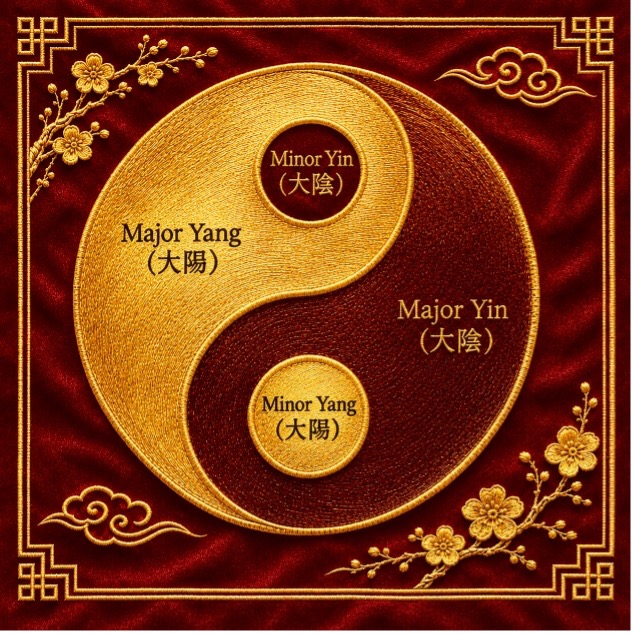
Figure 3. The Taijitu as we know it today.
From the perspective of Traditional Chinese Medicine (TCM), the relationships between Yin and Yang are understood through four fundamental principles that act interdependently:
1. Opposition and mutual restraint
Yin and Yang represent opposing yet complementary qualities that regulate one another. This opposition allows limits to be established and a relative balance to be maintained.
In the body, TCM traditionally associates Yin with aspects such as the interior, structure and bodily fluids; and Yang with the exterior, activity, and the functions of warmth and movement.
2. Growth and decline
Yin and Yang are in a state of constant change: when one increases relatively, the other may decrease. This alternation helps us to understand natural rhythms.
For example, the cycle of day and night: during the day, Yang qualities—associated with light and activity—predominate; during the night, Yin qualities—linked to darkness and rest—predominate.
3. Interdependence
Yin and Yang do not exist in isolation: each requires the other in order to manifest itself. In TCM, this relationship is expressed through the complementarity between structure and function.
The bodily structure, associated with Yin, provides the necessary support for activity; while the functions, associated with Yang, help to maintain and transform that structure.
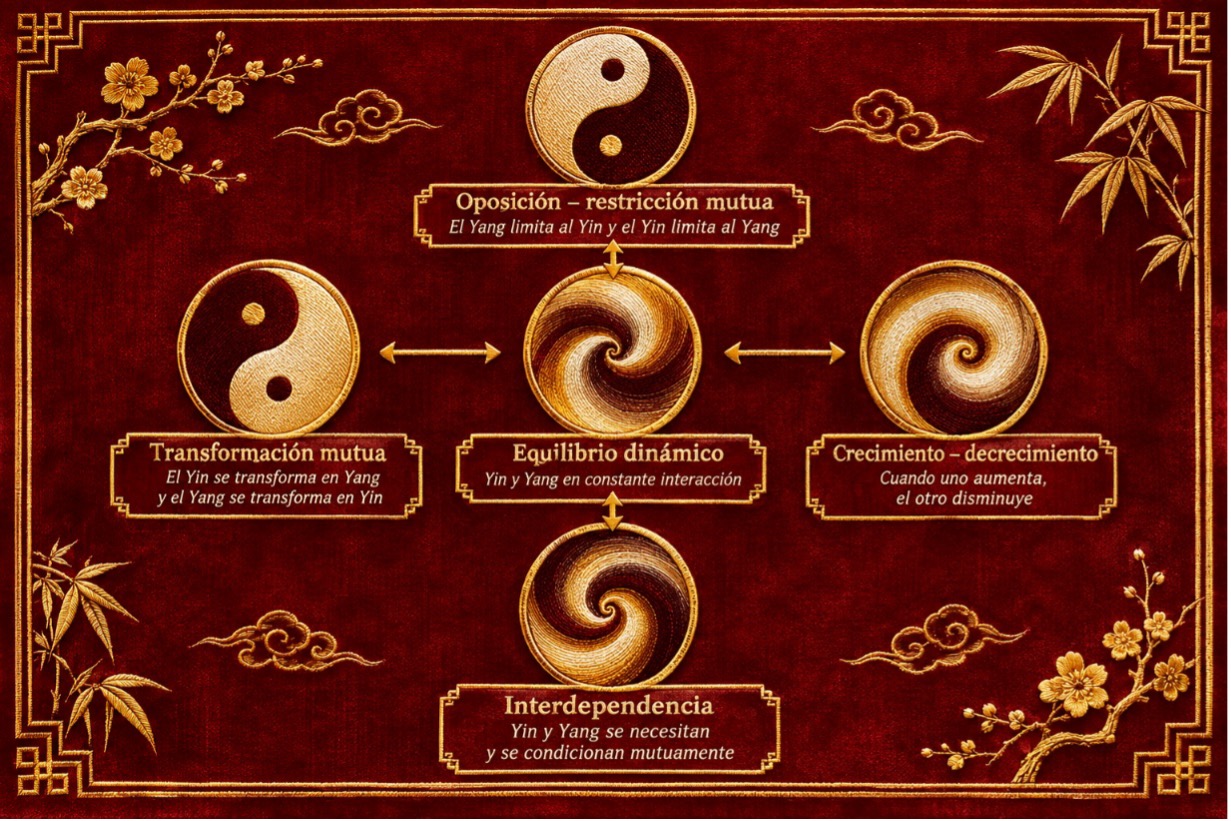
4. Mutual Transformation
Under certain conditions, Yin and Yang can transform into one another. Transformation is an expression of the changing nature of phenomena.
We can recognize this transition in the passage from night to dawn, when darkness and stillness gradually give way to light and activity.
Dynamic balance. The Center.
Yin and Yang are neither static states nor independent entities, but complementary aspects of a reality in constant transformation. Their relationships can be expressed in different configurations, in which structure and function, permanence and change, are mutually conditioned.
Each configuration represents a momentary expression of a dynamic equilibrium that never ceases to transform.
Figure 4. The dynamic balance of Yin and Yang. An artistic representation of their diverse expressions and relationships of complementarity, relative predominance and transformation. The figures illustrate possible interactions, not successive stages of a cycle.
The four principles of Yin-Yang theory describe different relationships that can manifest simultaneously and in a state of constant transformation. To illustrate them, we have created a graphic representation based on dynamic equilibrium as a common center, showing four possible expressions of the interaction between Yin and Yang.
This visual interpretation does not represent successive stages or fixed states, but rather a way of approaching the complementarity, reciprocal regulation and continuous transformation that characterize this theory.
The Flow of Yin and Yang Forces in the Human Body in Different Aspects of its Physiology
| Aspect | Yin | Yang |
| Nature | Cold, darkness, stillness | Heat, light, activity |
| Movement | Descending, inward | Ascending, outward |
| Body | Interior, lower part, structure | Exterior, upper part, function |
| Traditional functions | Nourishing, moistening, storing | Warming, moving, transforming |
| Natural cycles | Night, autumn and winter |
Day, spring and summer |
The table below shows the different aspects in which the Yin and Yang forces manifest themselves in the body.
Aspect Yin Yang
Nature Cold, darkness, stillness Heat, light, activity
Movement Descending, inward Ascending, outward
Body Interior, lower part, structure Exterior, upper part, function
Traditional functions Nourishing, moistening, storing Warming, moving, transforming
Natural cycles Night, autumn and winter Day, spring and summer
In our next installment, we will continue this journey from the map of the sky to the map of the body to discover how the theory of the five phases, or Wu Xing, establishes correspondences between the cycles of nature, the organs and the functions of the human body from the perspective of Traditional Chinese Medicine.
A fresh perspective from which to explore how this tradition interprets the relationships that connect human beings with their environment.
Special note
This article is intended solely for educational and cultural purposes. The concepts presented form part of the theoretical framework of Traditional Chinese Medicine (TCM) and are not a substitute for diagnosis, treatment or follow-up by a healthcare professional. If you experience any discomfort or medical condition, we recommend consulting your trusted doctor. TCM practices may be considered complementary to conventional medical care, but should not replace prescribed treatments.
Sources:
1.Arumugam, S., Watanabe, K. (2017). Japanese Kampo Medicines for the Treatment of Common Diseases: Focus on Inflammation. United Kingdom: Academic Press., p. 16. Web 29 October 26 ISBN 978-0-128-09444-0.
2.Louis, F. (2003). The genesis of an icon: The “Taiji” diagram’s early history. Harvard Journal of Asiatic Studies, 63(1), 145–196. [Web 29 October 26] https://doi.org/10.2307/25066694
3.Wang, Robin. (2005). Zhou Dunyi’s Diagram of the Supreme Ultimate Explained (Taijitu shuo) : A Construction of the Confucian Metaphysics. Journal of the History of Ideas. 66(3): 307-323.
DOI:10.1353/jhi.2005.0047. [Web 29 October 26] https://www.researchgate.net/publication/236815848_Zhou_Dunyi’s_Diagram_of_the_Supreme_Ultimate_Explained_Taijitu_shuo_A_Construction_of_the_Confucian_Metaphysics
4. Me & Qi (2026). “Yin Yang TCM Concept”, Web 29 October 26. https://www.meandqi.com/knowledge-base/concepts/yin-yang#overview
5. Ivankovic, Milorad (2024), “The Sinicized Chinese Form of the Vedic Doctrine of Adhvācāra” – Scientific Figure on ResearchGate. [Web 29 October 26] https://www.researchgate.net/figure/FIGURE-B-The-earliest-swirling-reverse-S-like-shape-design-of-the-Yin-Yang-diagram_fig1_380323698
FIND OUT MORE!