
Newsletter | March 2026
TO TAKE CARE OF WHAT WE LOVE AND TO HOLD WHAT MAKES A CHANGE
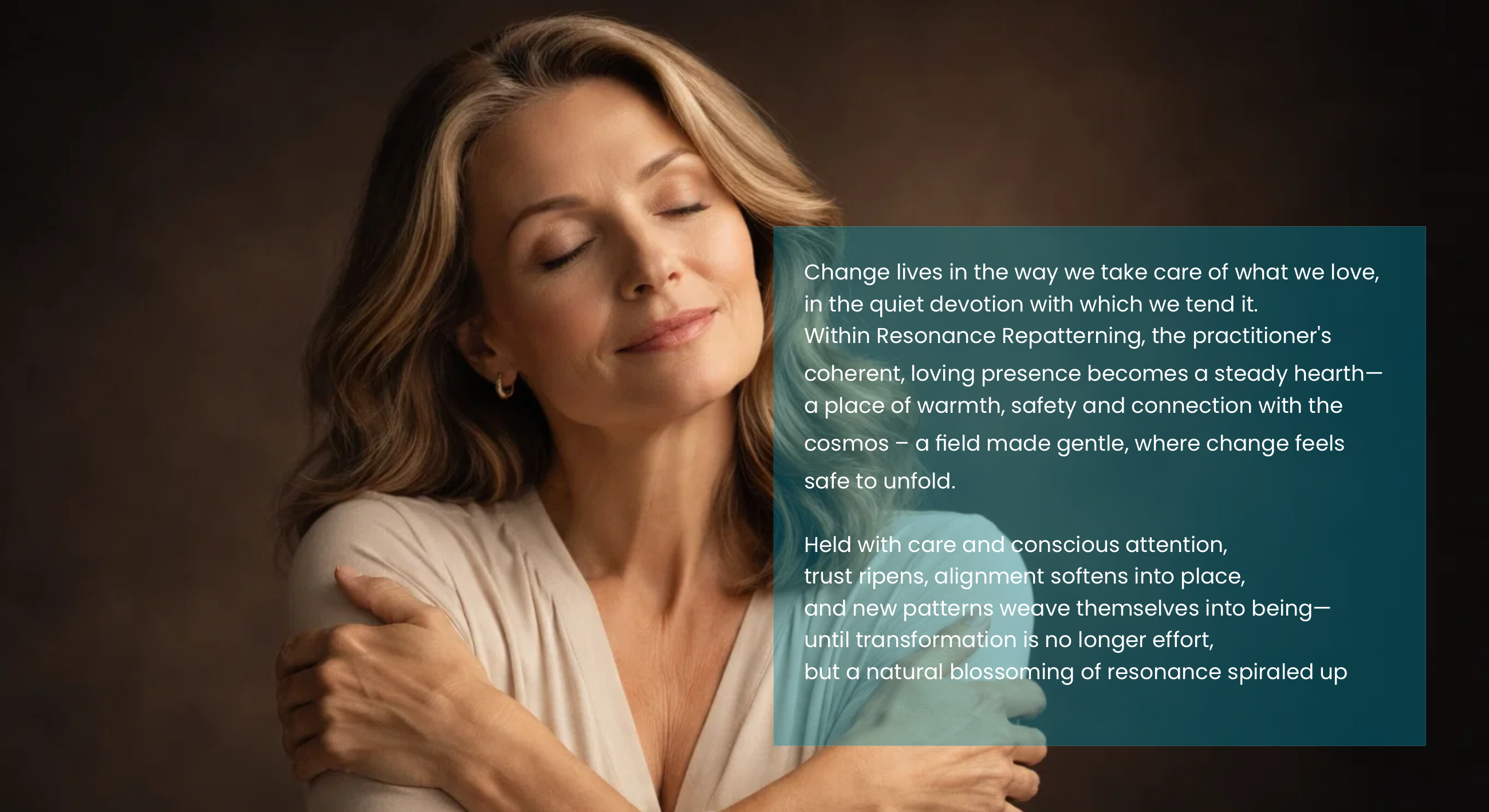

Change lives in the way we take care of what we love, in the quiet devotion with which we tend it. Within Resonance Repatterning, the practitioner’s coherent, loving presence becomes a steady hearth— a place of warmth, safety and connection with the cosmos – a field made gentle, where change feels safe to unfold. Held with care and conscious attention, trust ripens, alignment softens into place, and new patterns weave themselves into being— until transformation is no longer effort, but a natural blossoming of resonance spiraled up
TO TAKE CARE OF WHAT WE LOVE AND TO HOLD WHAT MAKES A CHANGE
I would like to begin this reflection by talking about something that unites us all, beyond any role we may play: to care.
As Resonance Repatterning® practitioners, it is vital to take care of the space that opens up in a session, to care for the person who places their trust in us, and to care for the method that, over the years, has accompanied processes of transformation in so many lives around the world.
Resonance Repatterning® is not just a set of tools. It is a process that touches memories, emotions, and patterns that have been active for a long time in the unconscious. A Resonance Repatterning® session is a space that requires presence, sensitivity, and responsibility.
When someone decides to receive a session, they are placing their trust in the system and in the practitioner. They share a part of their story. They are allowing us to accompany them at a sensitive time in their life. That act deserves to be sustained with clarity, consistency, and professional ethics.
Regardless of whether we provide sessions professionally in active practice, or whether we remain connected to RR® by taking care of ourselves and those close to us, we share the responsibility of taking care of the integrity of the system and the legacy that sustains it.
From this place of care, we understand that all therapeutic practice requires structure, support, and clear standards. And it is here that the License to Practice finds its true meaning.
The License to Practice is not a distant formality. It is a concrete way to remain connected to the Institute created by Chloe F. Wordsworth, which is entrusted with safeguarding and transmitting her teachings while maintaining her high standards. It is also a way to walk together, to have guidance when we need it, and to sustain the practice within a clear and respectful formal framework.
The Institute exists to accompany, guide, and protect the essence of the RR® system. It functions as a space of reference and support for instructors, practitioners, students, and also for those who seek to receive sessions with peace of mind and confidence.
In a time when information circulates rapidly and many teachings are reinterpreted in different ways, maintaining an active License to Practice is also a loving way to protect what we value. It is a reminder that Resonance Repatterning® has a structure, authorship, and depth that deserve to be honored.
Every certified practitioner who maintains their valid License to Practice strengthens public trust and contributes to ethically and responsibly sustaining Chloe’s living legacy.
If you are part of this community, we invite you to look at your connection to the method from this place of care. And if you are in training or in a moment of transition in your practice, remember that the Institute is here to accompany you with clarity and closeness.
Maintaining consistency is not only a professional responsibility inherent to the RR system. It is a way of honoring the human space that opens up in every encounter between a practitioner and a client, between a teacher of the system and a practitioner. It is caring for the trust that others place in us. It is keeping alive the essence of a work that continues to generate transformation in the world.
With deep gratitude for walking together, until our next edition.
Ylleana, Norma and Nuria
Resonance Repatterning International Institute Board of Directors
This content is authored by Norma Garcia

CHLOExperiences
“This is our potential: to ascend in a spiral so that the spirit permeates and radiates us, allowing us to radiate our light.”
Wordsworth, Chloe F. (2017), “¡Asciende en Espiral! 127 Opciones Energetizantes para Realizar tu Potencial Ahora” primera edición en español, 2017, Resonance Publishing, p. xxvii

SpiralMarketing
Quantum Storytelling: The Art of Telling Transformational Stories.
How to create messages that elevate, inspire, and move others through inner resonance.
Stories have always been portals. Long before strategies, brands, or digital platforms existed, human beings gathered around fire to share stories that offered meaning, direction, and belonging. Today, although the setting has changed, the power of storytelling remains the same: stories continue to be the deepest language of transformation.
From a conscious perspective, communication is not just about delivering information; it is about opening fields of possibility. Every story we share carries a frequency. It is not only about what is said, but from where it is spoken. Quantum storytelling recognizes that words are never neutral — they hold energy, intention, and memory.
When a story is born from inner coherence, it does not seek to convince or impress. It seeks to resonate. And it is this resonance that allows a message to reach those who are ready to receive it. At this level, storytelling is not a technique; it is an act of presence.
Quantum storytelling transforms because it does not appeal to logic alone, but to lived experience. It is not built from a perfect script, but from integrated understanding. When you share something that has been lived, processed, and embodied, your message becomes authentic — and authenticity always moves people.
Telling stories that transform carries a subtle responsibility:
- To honor your own journey without exaggerating or diminishing it.
- To share from clarity, not from an unhealed wound.
- To understand that your story is not for everyone, but for those who resonate with it.
From this perspective, storytelling stops being linear and becomes expansive. A story does not create impact because it is well structured, but because it vibrates in coherence with the one who tells it. When that happens, the message is not imposed — it is offered.
March invites us to revisit how we tell the stories of what we do, what we believe, and how we support others. Not to refine speeches, but to align intention and expression. Because a story shared from presence does more than communicate — it creates space for others to remember their own truth.
In a world overloaded with messages, choosing to tell transformational stories is a conscious act. It is trusting that the right resonance always finds its way. And it is understanding that when a story is born from the center, it needs no embellishment — its energy is enough.
This content was written by Américo Espinoza

FOCUS
Focus on the balance of the 5 elements for a better life.
Flowing with the energy of the five elements of acupuncture.
It is our pleasure to welcome you to the March 2026 edition of the International Institute of Resonance Repatterning newsletter.
As we delved deeper in our learning of Chinese metaphysics, we were introduced to the key concepts of Qi, the yin yang duality and the concepts of the 10 Heavenly Stems and the 12 Earthly Branches which from the pillars of the Bazi reading in Feng Shui.
As Qi vibrates and interacts with the five elements of nature, it confers them their yin/yang duality. Therefore, the elements are associated with the Four Phenomena – Major Ying, Minor Yang, Major Yang, Minor Ying.
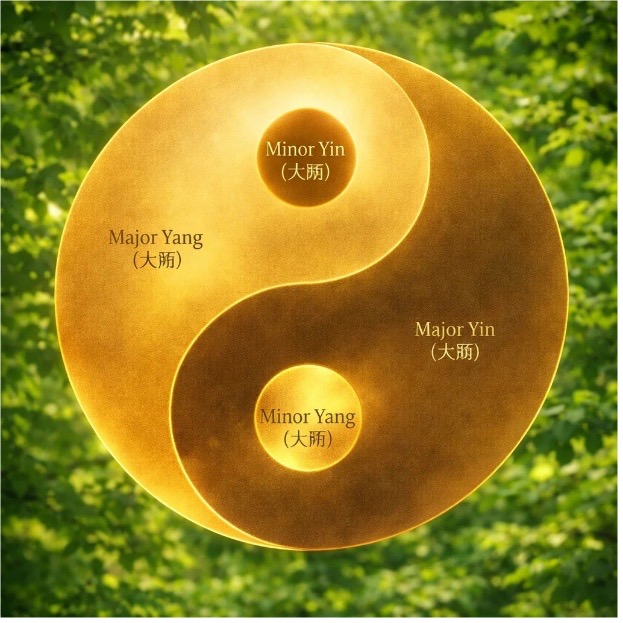
These Four Phenomena symbolize essential aspects of life and nature: the four seasons, the four cardinal points, the four stages of development – birth, growth, sickness and death -, and the four celestial animals: the Green Dragon, the Red Phoenix, the White Tiger and the Black Tortoise.
The Five Element Theory was used widely as a system to understand the universe – Han Dinasty (25 to 220 AD). It was used to interpret the interactions and relationships of the natural world, in music, Feng Shui, military strategy, in the Chinese Traditional Medicine and the arts. This system was the foundation of the study of the different systems in Chinese history. Let’s remember that the five elements represent more than just physical things. They also classify abstract concepts.
The five elements were thought to be associated with the five major planets, Jupiter, Saturn, Mercury, Mars, and Venus, and with the Confucianist five best qualities of human beings: benevolence (wood), righteousness (metal), propriety (fire), wisdom (water) and sincerity (earth).
The 10 Heavenly Stems and the 12 Earthly Branches allow us to derive in-depth insights into a person’s character, potential, and destiny just by their mere appearance on a Bazi Chart. The Heavenly Stem of your Day of Birth is referred to as the “Day Master.” Your Day Master represents your basic nature, your characteristics, your behavior, even your appearance. The Day Master is your personal element.
WOOD
The Wood element is represented by vegetation, where tall trees, small plants and shrubs are present. The concept of growth, upward progression and stability are encompassed by these nature symbols. Wood is also aligned with Spring, which embodies the concepts of expansion, and vitality.
The next table features some of the general wood element characteristics:
|
WOOD |
|
|
PLANET |
JUPITER |
|
YANG WOOD |
JIA |
|
YIN WOOD |
YI |
|
HEAVENLY CREATURE |
GREEN DRAGON |
|
SEASON |
SPRING |
|
FOUR PHENOMENA |
MINOR YANG |
|
COMPASS DIRECTION |
EAST |
|
QI |
WIND |
|
COLOUR |
GREEN |
|
BODY PARTS |
LIVER GALL BLADDER |
Wood frequency is also connected with being full of hope when expressing your assertiveness and creativity. Wood likes to make plans and make good decisions towards growth and development. You live focused, motivated, and manifest your intentions and objectives. Wood is also related with self-esteem.
When wood is non coherent, you may feel desperate, with no plans and objectives of your own. You cannot generate new projects, you have a blockage to generate creative ideas, and might not be taking any good decisions. Maybe you are frustrated because you cannot grow and feeling angry because you are not capable of changing. You feel stuck
JIA – YANG WOOD
Jia Wood is the first of the Ten Heavenly Stems in the Bazi (Four Pillars of Destiny) system and represents the Yang aspect of the Wood element. It symbolizes growth, vitality, resilience, and upward expansion, much like a strong oak tree in spring.
Core Symbolism
Jia Wood is compared to a tall, deeply rooted tree—upright, sturdy, and constantly growing toward the light. It represents strength, ambition, principle, stability, and industrious effort. With strong “roots,” Jia individuals value solid foundations in life, preferring stability over frequent change.
Key Personality Traits
- Dynamic and Growth-Oriented – Highly motivated, hardworking, and always developing ideas.
- Resilient and Dependable – Protective, selfless, and reliable; often providing support to others.
- Principled and Straightforward – Honest, direct, sometimes blunt; focused on the bigger picture.
- Nurturing and Benevolent – Patient, kind, and willing to help, symbolically offering “shade and protection.”
Challenges
When overly strong in the birth chart, Jia Wood may become rigid, stubborn, conservative, and resistant to change. Their directness can appear tactless. Difficulty adapting under pressure may lead to stress or emotional strain. Like the tallest tree, their visibility and ambition can make them vulnerable to competition or exploitation.
Gender Expression (Energy Polarities)
- Men often display independence, resilience, integrity, and clarity of purpose.
- Women tend to express generosity, harmony-building qualities, innovation, and professional consistency.
Functional Qualities in Bazi
Jia Wood individuals are often effective in supportive or behind-the-scenes roles. They are skilled at utilizing available resources and people to expand their ideas. Full chart analysis—including hour, day, month, and year pillars—is necessary for precise interpretation, particularly when applying Useful Gods and temperature adjustment theory.
Cultivation and Alignment
To harmonize Jia Wood energy:
- Emphasize growth-oriented qualities—learning, expansion, kindness, and health.
- Support liver and gallbladder health through proper diet, particularly plant-based foods and herbs.
- Pursue careers aligned with “growth” industries, such as education, health, research, plants, design, beauty, or any field centered on development.
Overall, Jia Wood represents principled growth, rooted strength, and benevolent leadership—thriving when balanced between firmness and flexibility.
YI WOOD
Yin Wood (Yi Wood) Daymaster in Bazi
Yi Wood is the second of the Ten Heavenly Stems in the Bazi (Four Pillars of Destiny) system and represents the Yin aspect of the Wood element. Symbolized by flowers, grass, vines, and softwood, Yi Wood embodies flexibility, adaptability, elegance, and quiet resilience.
Unlike Jia (Yang Wood), which resembles a strong oak tree, Yi Wood is compared to climbing vines or grass that bends with the wind. Rather than confronting obstacles directly, Yi Wood individuals navigate around them. Their strength lies in subtlety, diplomacy, and strategic adjustment. Though they may appear delicate, they are highly resilient and possess a strong survival instinct.
 Core Characteristics
- Diplomatic and Charismatic – Yi Wood individuals are tactful, persuasive, and skilled at diffusing conflict. Their civility and political awareness make them effective leaders and negotiators.
- Adaptable and Strategic – They quickly adjust to changing circumstances and often find indirect routes to success.
- Intelligent and Quick-thinking – They identify the core of problems and generate practical solutions efficiently.
- Selfless and Considerate – They often prioritize others’ needs and consider multiple perspectives before acting.
- Determined Under Pressure – Although gentle in demeanor, they become persistent and resourceful when challenged.
Potential Challenges
Yi Wood individuals can be indecisive, fickle, or overly accommodating to maintain harmony. Their flexibility may become inconsistency, as they may change direction frequently or avoid firm commitments. Emotional sensitivity can also cloud objectivity in high-stress situations.
Gender Expressions (Energy Polarities)
- Men with Yi Wood energy tend to be charming, strategic, patient, and romantically fortunate. They are well suited to advisory, planning, or counseling roles.
- Women often express quiet strength, independence, strategic thinking, and loyalty to family and close relationships.
Symbolic Meaning
Yi Wood represents upward growth toward light—like vines climbing walls or trees. It reflects the capacity to thrive through adaptation rather than force. In Bazi analysis, the balance of the chart, including the influence of Useful Gods and temperature adjustment, determines how harmoniously this adaptable energy is expressed.
Overall, Yi Wood signifies graceful resilience, strategic intelligence, and the power of flexibility as a path to long-term growth.
In our April edition, we will learn about the yin and yang qualities of Fire.
See you next time!
This content was written by Nuria Becerril
Sources:
Chloe F. Wordsworth, (2017), LOS PRINCIPIOS DE LAS RELACIONES CON RESONANCE REPATTERNING. The Resonance Repatterning Series, Libro 7, sexta edición.
Imperial Harvest, “FIVE ELEMENTS IN CHINESE METAPHYSICS”, Web. Posted on 18 August 2023. Taken on 25 February 2026 from https://imperialharvest.com/blog/five-elements/
Imperial Harvest, “UNDERSTANDING YOUR DAYMASTER – JIA WOOD”, Web. Posted on 26 May 2023. Taken on 25 February 2026 de https://imperialharvest.com/blog/understanding-jia-wood-daymaster/
Imperial Harvest, “UNDERSTANDING YOUR DAYMASTER – YI WOOD”, Web. Posted on 01June de 2025. Taken on 26 Februrary 2026
Scribd, 2014; Yi Wood Day Master (Yin Wood Character). Scribd.com Web. Posted on 01Apr2014 Taken on 25February 2026 from https://www.scribd.com/document/215654346/Day-Master-Wood-Yin
Scribd, 2014; Yang Wood Traits in Bazi Analysis. Scribd.com Web. Posted on 25Feb2014 Taken on 25February 2026 from https://www.scribd.com/document/209118761/Day-Master-Wood-Yang
Scribd, 2012; Ten Heavenly Stems. Scribd.com Web. Posted on 03Sep. 2012 Taken on 25February 2026 from https://www.scribd.com/document/104803022/Ten-Heavenly-Stems

RRMomentum
Retiro RR® | 1-3 May, 2026 | Tepoztlán.
Resonance Repatterning® Experiences & Events
It is not about starting from scratch. It is about beginning from a more conscious place.
This May, we gather in Tepoztlán for a profound transformational experience with Resonance Repatterning®. If you feel the call, this may be your moment.
Limited space available. Request information and reserve your place.
FIND OUT MORE!